
The Leverage Trap: Navigating Market Volatility and Preserving Capital

The Leverage Trap: Navigating Market Volatility and Preserving Capital
During the first half of 2026, South Korea's semiconductor stocks remained among the strongest performers in equity markets, driven by extraordinary optimism surrounding artificial intelligence (AI). Samsung Electronics and SK hynix, the world's leading producers of High Bandwidth Memory (HBM), became two of the largest beneficiaries of this trend as demand for AI accelerators and high-performance memory continued to exceed expectations. Strong earnings, rising capital expenditure by hyperscale cloud providers, and optimistic forecasts for AI infrastructure investment reinforced investor confidence, pushing semiconductor valuations to historically elevated levels.
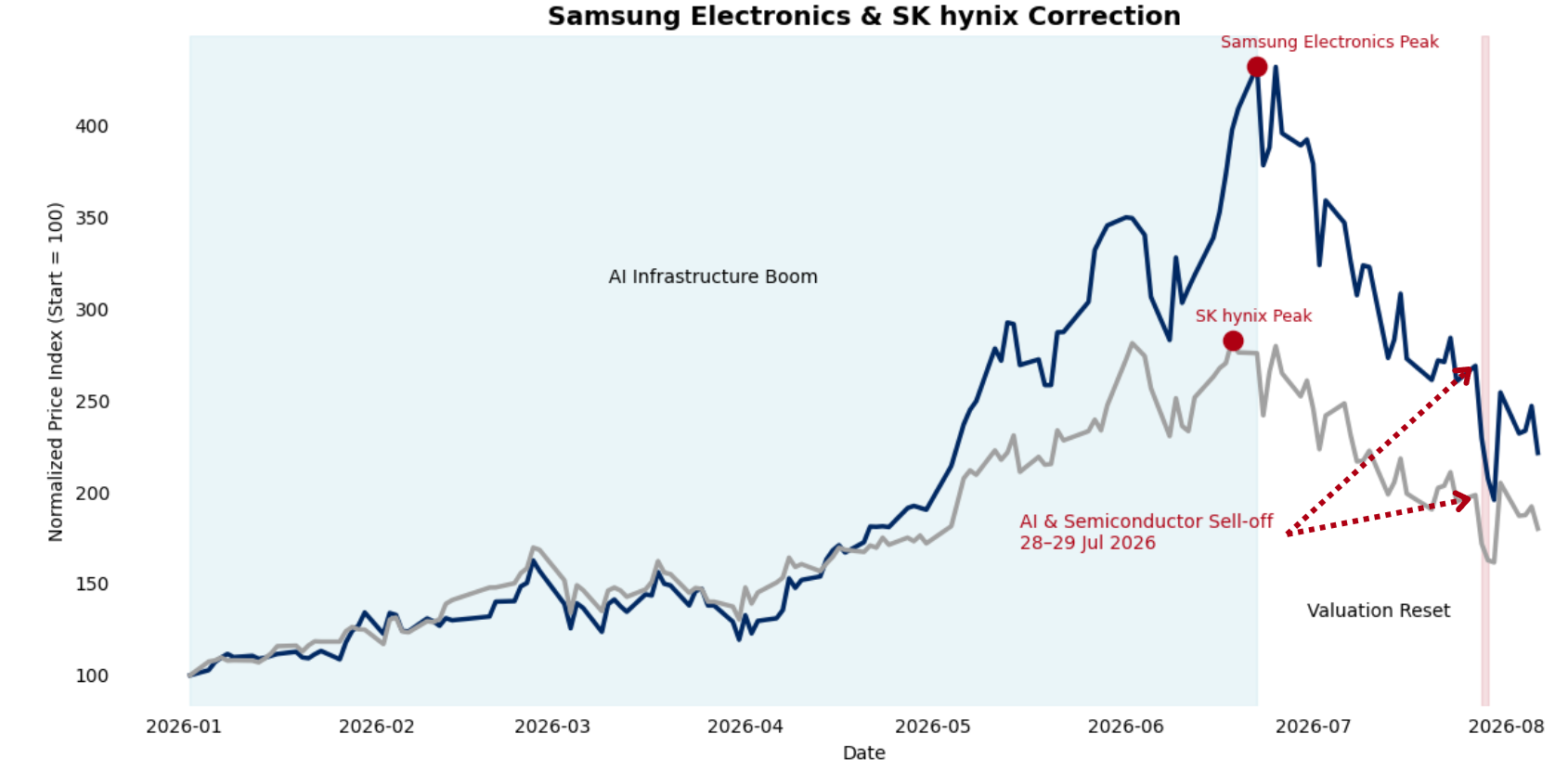
Sources: Yahoo Finance (yfinance) Analyze by Metta Associate.
Market sentiment began to shift during the second half of the year as investors reassessed whether the pace of AI-driven investment could be sustained indefinitely. Concerns emerged over the possibility of slower growth in hyperscaler capital expenditure, increasing competition from Chinese memory manufacturers, and the risk that aggressive capacity expansion could eventually lead to an oversupply of HBM. At the same time, elevated valuations left little room for disappointment, making semiconductor stocks increasingly vulnerable to even modest changes in expectations.
The reassessment accelerated as investors rotated away from high-valuation growth stocks amid a higher-for-longer interest rate environment and greater emphasis on earnings quality, free cash flow generation, and valuation discipline. Rather than questioning the long-term potential of artificial intelligence, the market began questioning the timing, magnitude, and sustainability of future earnings growth. As expectations were revised downward, selling pressure spread rapidly across the semiconductor sector.
For investors employing leverage or margin financing, the impact was considerably more severe. Declining share prices reduced collateral values, triggering margin calls that forced some investors to liquidate positions regardless of their long-term investment convictions. These forced sales generated additional downward pressure on prices, creating a deleveraging cycle that amplified market volatility far beyond what changes in business fundamentals alone would have justified.
This episode highlights an important distinction between fundamental risk and market risk. The long-term investment thesis for AI infrastructure and advanced semiconductors remains broadly intact. However, when expectations become excessively optimistic and leverage becomes widespread, even a temporary adjustment in sentiment can trigger disproportionately large price movements. In such environments, leverage does not create the initial shock it amplifies its consequences.
The recent correction in South Korea's semiconductor sector therefore represents more than a sector-specific event. It illustrates a recurring pattern in financial markets: when strong conviction is combined with excessive leverage, even fundamentally sound investments can become vulnerable to forced selling and short-term dislocations. This mechanism has appeared repeatedly throughout financial history, regardless of the asset class or economic backdrop, and continues to serve as one of the most important lessons in risk management.
Ultimately, the critical question for investors is not whether markets will experience corrections; volatility is an inevitable characteristic of investing but whether their portfolios are resilient enough to withstand those periods without being forced to exit fundamentally sound investments. The greatest investment risk is often not being wrong about the long-term opportunity, but being unable to remain invested long enough for that opportunity to be realized.
Lessons from History
Every financial crisis is unique in its catalyst, yet remarkably similar in its underlying mechanics. Whether the trigger was sovereign debt, concentrated equity positions, cryptocurrencies, or shifting expectations surrounding artificial intelligence, history consistently demonstrates that leverage has often acted as the catalyst that transforms ordinary market corrections into systemic events.
In most cases, the crisis does not begin with leverage itself. Rather, it begins with growing conviction. Investors become increasingly confident in a particular investment thesis, market trend, or quantitative strategy. As confidence rises, leverage is employed to enhance returns and improve capital efficiency. While this approach can significantly amplify gains during favorable market conditions, it also reduces investors' ability to absorb unexpected volatility.
When market conditions change unexpectedly whether due to macroeconomic shocks, deteriorating liquidity, policy changes, or shifts in investor sentiment asset prices begin to decline. For leveraged investors, falling prices trigger margin calls, forcing the liquidation of positions to meet collateral requirements. These forced sales create additional downward pressure on prices, initiating a deleveraging spiral that can rapidly escalate localized losses into widespread market dislocations.
The following historical events illustrate that although markets, asset classes, and economic environments have evolved over time, the sequence leading to major financial losses has remained strikingly consistent.
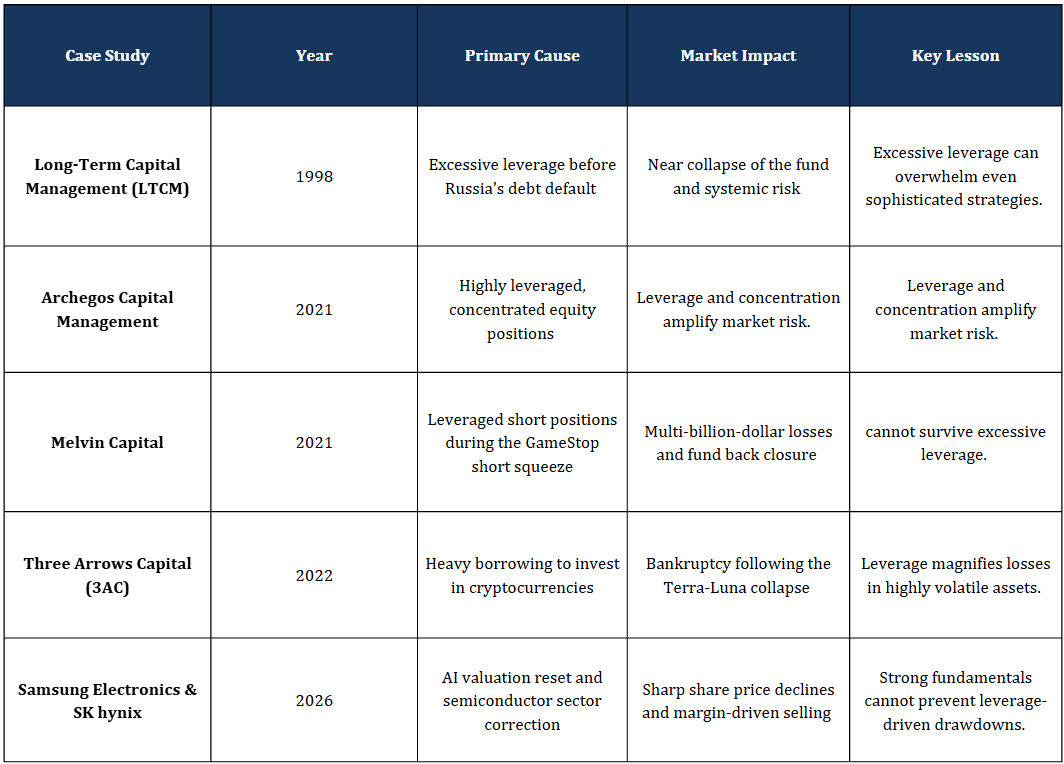
Sources: Federal Reserve Bank of New York, U.S. Securities and Exchange Commission (SEC), Congressional Research Service (CRS), Monetary Authority of Singapore (MAS), Teneo, Samsung Electronics, SK hynix, and Yahoo Finance via yfinance. Analysis by Metta Associates.
Although these events occurred across different decades, asset classes, and market environments, they all reveal the same underlying principle: leverage does not create investment mistakes, it magnifies their consequences. Once market expectations shift and liquidity begins to tighten, leverage transforms temporary volatility into forced liquidation, increasing both the speed and magnitude of market declines.
Recognizing this recurring pattern is essential for investors. While the catalysts behind every crisis may differ, the mechanics of excessive leverage have remained remarkably consistent throughout financial history. Understanding these patterns enables investors not only to interpret current market events more effectively but also to better prepare for future periods of heightened volatility.
The Anatomy of a Leverage Crisis
Although each financial crisis is triggered by different events, the underlying sequence that transforms a market correction into a severe financial disruption has remained remarkably consistent. The case studies presented earlier demonstrate that regardless of the asset class, geography, or investment strategy, excessive leverage tends to amplify market stress through the same self-reinforcing mechanism.
The process typically begins with strong conviction. Investors develop increasing confidence in a particular investment theme, whether it is quantitative arbitrage, high-growth technology, cryptocurrencies, or artificial intelligence. As confidence grows, leverage is gradually increased to enhance returns and improve capital efficiency. During periods of rising asset prices, this strategy appears highly effective, reinforcing investors' belief that the underlying thesis is correct.
The turning point occurs when an unexpected event challenges market expectations. The catalyst may take many forms including deteriorating economic conditions, tighter monetary policy, declining liquidity, geopolitical developments, or changing investor sentiment but the outcome is often the same. Asset prices begin to decline, reducing the value of collateral supporting leveraged positions.
As collateral values fall, margin requirements increase. Investors who are unable to provide additional capital are forced to liquidate their positions. These forced sales place further downward pressure on market prices, triggering additional margin calls across the financial system. The result is a deleveraging spiral in which declining prices generate forced selling, and forced selling accelerates further price declines.
This mechanism explains why market movements during periods of financial stress often appear disproportionate to changes in underlying business fundamentals. In many cases, prices are driven less by investors' reassessment of intrinsic value than by the urgent need to reduce leverage and restore liquidity.
Understanding this sequence is particularly important because it shifts the focus away from predicting the next crisis and toward recognizing the conditions that make markets vulnerable. While the catalyst behind every crisis is different, the mechanics of excessive leverage have changed very little over time.
For long-term investors, the objective is therefore not to eliminate market volatility, but to build portfolios that can withstand periods of severe market stress without being forced to sell fundamentally sound investments at precisely the wrong time. In this context, prudent risk management is not about avoiding uncertainty, it is about preserving the ability to remain invested until long-term fundamentals ultimately prevail.
Survival: The First Principle of Investing
Across episodes ranging from Long-Term Capital Management (LTCM), Archegos Capital Management, Melvin Capital, and Three Arrows Capital to the recent correction in Samsung Electronics and SK hynix, history delivers a consistent lesson: investment failures are rarely caused by an incorrect thesis alone. More often, they result from an inability to survive periods when markets move sharply against expectations.
Leverage can enhance returns during favorable conditions, but it also amplifies losses and increases vulnerability to market volatility. When margin calls force investors to liquidate positions, temporary losses can quickly become permanent capital impairment, regardless of the underlying fundamentals.
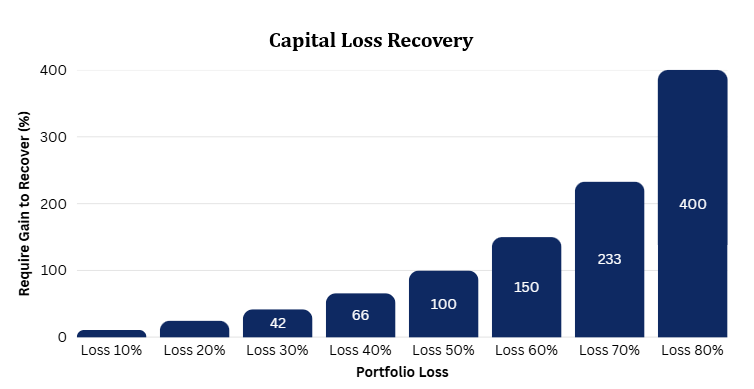
Sources: Metta Associate.
The mathematics of investing is unforgiving. A 50% loss requires a 100% gain to recover, while an 80% loss requires a 400% gain. As a result, preserving capital is often more important than maximizing short-term returns.
As Warren Buffett famously observed, "Rule No. 1: Never lose money. Rule No. 2: Never forget Rule No. 1." The message is not that losses are unavoidable, but that avoiding severe and irreversible capital destruction is essential for long-term success.
Ultimately, successful investing is not about achieving the highest returns in every market cycle. It is about preserving capital, managing risk with discipline, and remaining invested long enough to benefit from the power of compounding.
"You cannot compound if you cannot survive."
This simple statement captures the central message of this article. Compounding the single most powerful force in long-term investing is only possible for investors who preserve their capital, withstand periods of market stress, and remain invested long enough for the underlying fundamentals to prevail.
Key Takeaways
- Leverage is a double-edged sword. It amplifies returns during favorable markets but magnifies losses when conditions deteriorate.
- History repeats the same lesson. From LTCM and Archegos to Three Arrows Capital and the recent South Korean semiconductor correction, excessive leverage, not simply an incorrect investment thesis, has consistently been the catalyst for catastrophic losses.
- Margin calls transform volatility into crisis. Forced liquidations can drive prices well below intrinsic value, creating a self-reinforcing deleveraging cycle.
- Protecting capital is more important than maximizing returns. A 50% loss requires a 100% gain to recover, highlighting the importance of disciplined risk management and avoiding permanent capital impairment.
- Long-term wealth belongs to investors who survive. Sustainable compounding requires preserving capital, maintaining liquidity, and remaining invested through every market cycle.
Metta Associates's Strategic Reflection
The recent correction in South Korea's semiconductor sector, together with historical episodes such as LTCM, Archegos, Melvin Capital, and Three Arrows Capital, reinforces a timeless investment principle: long-term wealth creation depends not only on identifying opportunities, but on preserving the ability to remain invested through periods of uncertainty.
At Metta Associates, we view leverage as a financial tool not an investment strategy. While it can improve capital efficiency, excessive leverage can quickly transform temporary market volatility into permanent capital impairment.
Our investment philosophy is built on resilience rather than prediction. We continue to believe in the long-term structural growth of AI, semiconductors, software, and digital infrastructure. However, enduring investment themes will inevitably experience periods of significant volatility, making disciplined risk management and capital preservation essential.
Ultimately, successful investing is not about avoiding every market correction, but about preserving capital, remaining invested, and building resilient portfolios allowing the power of compounding to work over time.
At Metta Associates, this is more than an investment quote; it is the foundation of our investment philosophy: preserve capital, manage risk with discipline, and stay invested for the long term. - always with you.
Disclaimer
The information presented is based on sources believed to be reliable; however, its accuracy or completeness cannot be guaranteed. This material does not represent a forecast and should not be interpreted as a guarantee of future outcomes. It has been prepared with care and objectivity to support long-term, planning-focused financial decisions.