
Volatility of Returns: Why a Smoother Journey Can Improve Compounding
Volatility of Returns: Why a Smoother Journey Can Improve Compounding
Two portfolios might seem identical if you only look at their average returns. However, their final values can end up completely different—especially if one grows smoothly while the other experiences wild ups and downs.
This is the importance of Volatility of Returns. It shows how much investment returns move up and down over time. Higher volatility does not always lead to a worse result, but when average returns are similar, larger fluctuations can make compounding less efficient and outcomes less predictable.
How Volatility of Returns Shapes Long-Term Outcomes
To illustrate the effect of volatility on long-term wealth, we use global equities as a reference point. Historically, global stock returns have shown annualised volatility of approximately 17%. To isolate the effect of volatility, we compare this with a Lower-Volatility Scenario at approximately 9% and a Higher-Volatility Stress Scenario at approximately 35%. All three scenarios are built with the same assumed average annual return.
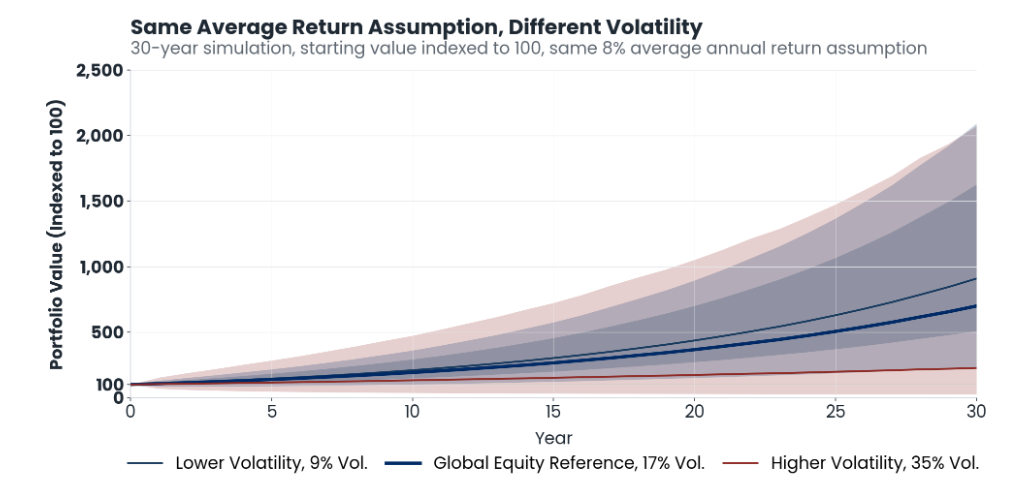
Illustrative example only. Higher volatility creates a wider range of possible outcomes and may reduce median compounded wealth, even when the average annual return assumption is unchanged. Illustrative simulation only: 50,000 lognormal annual-return paths over 30 years, calibrated to the same 8% expected arithmetic average annual return. Volatility assumptions are 9%, 17%, and 35% annualised, respectively. Lines show median outcomes; shaded bands show 10th–90th percentile ranges. This is not a forecast or guarantee of future returns. Prepared by Metta Associates for illustrative and educational purposes only. Not investment advice.
The chart shows how different the outcomes can become over time, even when the average return assumption is unchanged. The Lower-Volatility Scenario follows a steadier growth path, while the Higher-Volatility Stress Scenario produces a much wider range of possible outcomes. Higher volatility may allow for some very strong results, but it also increases the risk of severe capital impairment and leads to a lower median outcome over the 30-year period.
This is the practical challenge of Volatility of Returns. When annual returns fluctuate too widely, the final portfolio value becomes less predictable. Managing volatility does not guarantee a better result, but it can improve the reliability of compounding and support more realistic retirement and goal-based planning.
Why can the higher-volatility path end with less wealth even when the average return is the same? The answer lies in the drag that large losses create on compounding.
Why Volatility Creates a Drag on Compounding
When a portfolio loses value, it needs a larger percentage gain to return to its starting value. This is one of the most important reasons volatility can affect long-term compounding.
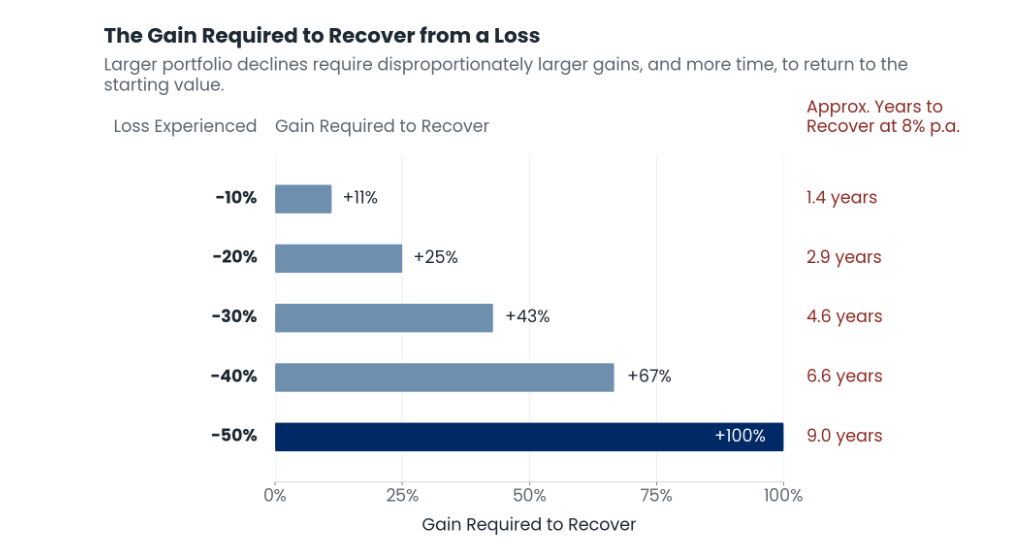
Illustrative example only. Recovery gain percentages show the gain required to return to the starting portfolio value after a loss. Approximate recovery time assumes a steady 8% annual compounded return after the loss; actual outcomes will vary. This is not a forecast or guarantee of future returns. Prepared by Metta Associates for illustrative and educational purposes only. Not investment advice.
The mathematics are straightforward. A 10% loss requires an 11% gain to recover. A 20% loss requires a 25% gain. If a portfolio declines by 50%, it needs a 100% gain, or a doubling of the remaining capital, just to return to its original value.
This imbalance helps explain why large fluctuations can reduce compounding efficiency. The deeper the decline, the more future return is required simply to recover previous losses. A portfolio with smaller and steadier movements may not always capture the strongest short-term gains, but it can reduce the time spent recovering from large drawdowns and allow more of the investment journey to be focused on long-term wealth growth.
Why This Matters for Retirement and Goal-Based Planning
Volatility matters most when investment capital has a purpose. For retirees, this may mean supporting regular withdrawals. For families, it may mean preparing for education funding, property purchases, business liquidity, or future inheritance planning. In each case, the portfolio is not only expected to grow; it must also remain available when the money is needed.
A highly volatile portfolio may still deliver strong long-term returns, but the journey can be harder to plan around. If a large decline occurs close to a withdrawal need or financial deadline, the investor may be forced to sell assets when the portfolio value is temporarily depressed. This can reduce the capital base and make future recovery more difficult.
This is why portfolio construction should consider both return potential and return stability. The objective is not to avoid every market fluctuation, which is impossible, but to build a portfolio that can support the family’s financial goals with a more reliable compounding path.
Key Takeaways
- Average return is not the full story: Two portfolios may share the same average return, but different levels of volatility can lead to different compounding outcomes.
- Large losses create a recovery burden: The deeper the decline, the larger the gain required to return to the starting value. This is why volatility can reduce compounding efficiency over time.
- Smoother compounding supports better planning: For retirees and families with future financial goals, return stability can make retirement income, liquidity planning, and goal-date planning more reliable.
Metta’s Strategic Reflection
At Metta Associates, we believe long-term wealth planning should not focus only on the average return a portfolio may achieve. It should also consider how that return is experienced through time, and whether the portfolio can remain resilient through different market conditions.
Volatility is not something investors can eliminate completely. Market fluctuations are a natural part of investing. However, unmanaged volatility can make compounding less reliable, increase the risk of large drawdowns, and create more uncertainty around retirement income and future financial goals.
This is why our investment approach places strong emphasis on diversification, downside awareness, and disciplined portfolio construction. The objective is not to avoid every short-term decline, but to build portfolios that can support long-term wealth with a more stable and sustainable compounding path - always with you.
Disclaimer
The information presented is based on sources believed to be reliable; however, its accuracy or completeness cannot be guaranteed. This material does not represent a forecast and should not be interpreted as a guarantee of future outcomes. It has been prepared with care and objectivity to support long-term, planning-focused financial decisions.