
Sequence of Returns: Why Timing Can Matter More Than Total Return

Sequence of Returns: Why Timing Can Matter More Than Total Return
In wealth planning, the average return is often used as a simple measure of long-term investment performance. While useful, it does not fully describe the actual path an investor experiences. A portfolio does not earn its return in a straight line. It moves through different market conditions year by year, and the timing of those gains and losses can meaningfully affect the capital available for future goals.
This is the concept behind Sequence of Returns: the order in which investment gains and losses occur over time. Sequence becomes especially important when money is being contributed, withdrawn, or required by a specific date. For a retiree drawing income, a market decline early in retirement can have a very different effect from the same decline occurring much later. For a younger investor who continues to contribute, the impact may be different, as lower prices can also create opportunities to accumulate assets over time.
Why Timing Matters More Than Averages
Most investors naturally focus on the average return. It is easy to understand and useful as a long-term reference point. However, it can hide an important reality: investment outcomes are shaped not only by how much return is earned, but also by when those returns occur.
When strong returns occur early, the portfolio may benefit from a larger capital base, allowing future returns to compound on a greater amount. When weak returns occur early, the portfolio may grow more slowly, leaving later gains to compound on a smaller base. This effect becomes even more significant when withdrawals are being made, because the investor may need to sell assets during a period of market weakness.
The central lesson is not that sequence always determines final wealth. Rather, Sequence of Returns shows that the timing of market performance matters most when it interacts with real-life cash flows: retirement withdrawals, ongoing contributions, education funding, estate planning, or any financial goal with a defined time horizon.
Different Outcomes from the Same Market Returns
Consider a retirement portfolio with an initial value of THB 10,000,000. Using a simplified 4% starting withdrawal rule, the portfolio is designed to support annual withdrawals of THB 400,000 for living expenses. Over a 30-year period, the portfolio is exposed to the same set of annual market returns, with the same average annual return of 8%. The only difference is the order in which those returns occur.
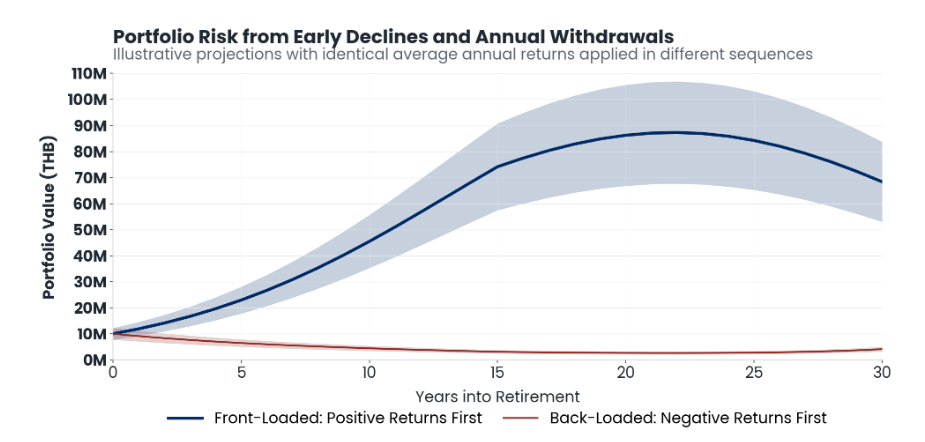
Illustrative example only. Each scenario uses the same THB 10,000,000 starting portfolio, THB 400,000 annual withdrawal, and the same 30 annual returns averaging 8.00% per year. The scenarios differ only by return order: the front-loaded path applies stronger returns in the early years while the back-loaded path applies weaker returns first. Shaded areas are stylised illustrative ranges around each path – not calculated confidence intervals or statistical forecasts. Prepared by Metta Associates for illustrative and educational purposes only. Not investment advice. Past performance is not indicative of future results.
As the graph illustrates, the timing of positive returns can lead to very different retirement outcomes, even when the same set of annual returns is used.
- Front-Loaded Positive Returns: In this scenario, stronger positive returns occur during the early years of retirement. Because these early gains more than offset the annual withdrawals, the portfolio is able to grow before facing weaker returns later in the period. This creates a larger capital base and a wider financial cushion, allowing the portfolio to continue supporting withdrawals even when market conditions become less favorable.
- Back-Loaded Positive Returns: In contrast, this scenario begins with weak or negative returns while the portfolio is still required to fund annual living expenses. Withdrawals may need to be made when portfolio values are depressed, reducing the capital base available for future recovery. Even as returns strengthen in the later years, they are applied to a portfolio that has already been significantly diminished, limiting the benefit of compounding.
Once withdrawals begin, the average return alone is no longer enough to describe the risk. The timing of returns becomes a major driver of retirement sustainability. A market decline early in the decumulation phase can be more damaging than the same decline occurring later, because the portfolio is facing both investment losses and ongoing withdrawals at the same time. Both portfolios survive the full 30-year horizon, but the outcomes differ by more than THB 64 million, despite identical average returns and identical annual withdrawals.
Key Takeaways
- Average return is a reference point, not a retirement outcome: An 8% average return can be useful for setting long-term expectations, but it does not guarantee that a portfolio will last for a specific period. Once withdrawals, contributions, or financial deadlines are involved, the order of returns can materially affect the result.
- The timing of positive returns affects compounding: When stronger positive returns occur early, the portfolio may build a larger capital base, allowing future returns to compound on a greater amount. When stronger positive returns arrive only later, they may have less impact if the portfolio has already been reduced by earlier losses or withdrawals.
- Withdrawal portfolios are especially exposed to early losses: For retirees, early market declines can be particularly challenging because the portfolio is being asked to do two things at once: absorb investment losses and fund living expenses. Selling assets during depressed market conditions can reduce the capital base available for recovery, increasing the risk that the portfolio may not sustain the planned withdrawal period.
Metta’s Strategic Reflection
Sequence of Returns risk is not merely a technical investment concept. It is a practical retirement planning challenge because it affects how much capital remains available when families need it most. The lesson is that long-term success is not only about the return a portfolio earns, but also about whether the portfolio can sustain withdrawals, absorb volatility, and remain aligned with important life goals through time.
At Metta Associates, we view risk management as an essential part of financial stewardship. Our focus is not only on pursuing return, but also on understanding how portfolios may behave under different market conditions, especially during periods of stress. This is why retirement planning should not rely only on simple average-return assumptions or static projections.
Instead, we believe financial plans should be tested through a range of possible outcomes. By using simulation-based planning, thoughtful diversification, disciplined withdrawal management, and appropriate downside control, we aim to help families prepare for uncertainty with greater clarity and confidence.
In our philosophy, successful wealth planning is not about avoiding uncertainty entirely. It is about preparing for it carefully, managing it with discipline, and making decisions that continue to support the family’s long-term security and peace of mind — always with you.
Disclaimer
The information presented is based on sources believed to be reliable; however, its accuracy or completeness cannot be guaranteed. This material does not represent a forecast and should not be interpreted as a guarantee of future outcomes. It has been prepared with care and objectivity to support long-term, planning-focused financial decisions.